Cervical Decompression: How It Works Without Surgery

If medications, physical therapy, or injections have not relieved your symptoms, considering “cervical decompression” can be concerning, especially if you are afraid that surgery may be your only option.
But decompression does not always mean surgery. It can also refer to nonsurgical traction performed on a padded table, using controlled stretching to relieve pressure without an incision or surgical recovery.
Understanding how nonsurgical cervical decompression works can help you feel more informed, less anxious, and better prepared to discuss your treatment options.
What Nonsurgical Cervical Decompression Actually Is
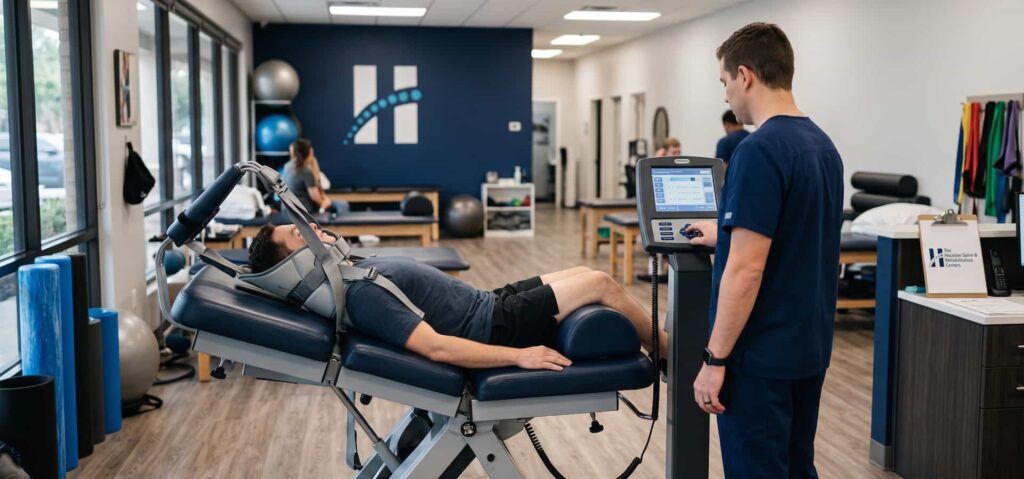
Nonsurgical cervical decompression therapy is a form of mechanical neck traction that uses gentle, controlled pulling to help relieve pressure in the cervical spine. No cutting, anesthesia, or incision.
During treatment, you lie face up on a motorized table with a padded head harness supporting your head and jaw. The device applies a carefully adjusted pulling force based on your body size, tolerance, and the area being treated.
The table alternates between pulling and releasing, helping ease muscle tension and reduce pressure on irritated joints or discs. By gradually relaxing the surrounding tissues, traction may allow the force to reach the targeted spinal structures more effectively.
How It Differs From Cervical Decompression Surgery
When a surgeon recommends cervical decompression, they may be referring to one of several procedures performed under general anesthesia.
- Anterior cervical discectomy and fusion (ACDF): Removes a damaged disc through the front of the neck and fuses the adjacent vertebrae.
- Laminectomy: Removes part of the bony arch at the back of a vertebra to create more space for the spinal cord.
- Foraminotomy: Enlarges the opening where a spinal nerve root exits the spine.
Nonsurgical neck decompression is not similar to any of them. It is a different intervention that relieves pressure and enhances mobility without opening the skin. However, it is not advisable for cases that genuinely require surgery.
What a Session Actually Feels Like
Nonsurgical cervical decompression feels like a gentle, controlled stretch, not a forceful pull. During a 15- to 20-minute session, you lie comfortably on your back with your head supported while the treatment applies a slow, mild stretch to your neck.
The sensation is often relaxing, and some people even fall asleep mid-session. Mild soreness afterward is possible, similar to what you might feel after trying a new exercise. If the stretch feels painful or too strong, tell your clinician so they can adjust the pressure or angle.
Which Neck Problems Does It Help?
Neck pain can present in different ways depending on its cause. Here are some causes of neck pain where nonsurgical cervical spine decompression can be beneficial.

Herniated or Bulging Cervical Disc
Cervical discs sit between the vertebrae, acting as cushions that absorb shock and allow your neck to move. When a disc’s outer layer weakens or develops a tear, its inner material may bulge or herniate outward, pressing on nearby nerve roots and causing pain, numbness, tingling, or weakness that travels into the shoulder or arm.
Pinched Nerve and Cervical Radiculopathy
Cervical radiculopathy occurs when a nerve root in the neck becomes irritated or compressed, causing symptoms that travel into the shoulder, arm, or hand. You may notice more than neck pain, including tingling, burning, numbness, or weakness that follows a specific pattern.
Degenerative Disc Disease and Foraminal Narrowing
Degenerative changes in the cervical spine usually develop gradually. Over time, discs may lose height, and the openings where nerve roots pass can narrow, potentially increasing pressure on nearby nerves and contributing to neck pain, stiffness, or arm symptoms.
When It Is Not the Right Treatment
Some symptoms need conventional care, not neck traction. If you are experiencing the following, seek medical assessment right away.
- Severe osteoporosis
- Recent cervical fracture or spinal fusion
- Vascular disease affecting the arteries in the neck
- Uncontrolled hypertension
- Suspected tumor, infection, or spinal instability
- Changes in bladder or bowel control
How to Decompress Your Neck at Home
You cannot replicate a clinical decompression table at home, and you should not try. Gentle movements, better posture, and supportive positions can help reduce strain on your cervical spine and restore comfortable neck movement.

Chin Tucks
Chin tucks are simple, gentle movements you can do at home to support better neck posture and ease tension. Follow these steps to keep the movement comfortable and effective:
- Sit or stand with your shoulders relaxed and your eyes level.
- Draw your chin straight back toward your throat, as if making a double chin.
- Keep your eyes level. You are retracting, not nodding.
- Hold for 5 seconds, then release.
- Repeat 10 times, two or three times a day.
Tip: If your gaze drops, you are nodding instead of retracting your chin.
Supported Supine Traction With a Rolled Towel
Supported supine traction, performed with a rolled towel, gently mimics the supported positioning used during cervical traction in an in-clinic setup. Follow these steps to help your muscles relax without forcing a stretch:
- Roll a hand towel into a cylinder about three inches thick.
- Lie on your back on the floor or a firm bed, and place the towel under your neck rather than under your head.
- Let your head rest back, and your jaw stay soft.
- Breathe normally for 5 to 10 minutes.
Tip: Stop immediately if your symptoms increase during movement.
Upper Trapezius and Levator Scapulae Stretches
Neck joint problems almost always come with a muscular component. The upper trapezius (shoulder-neck junction) and levator scapulae (neck-to-shoulder-blade muscle) carry most of it. Follow these simple stretches to gently ease tension in the neck and shoulders:
- Stretch the upper trapezius by sitting on one hand, tilting your opposite ear toward your shoulder, and holding for 30 seconds.
- Stretch the levator scapulae by sitting on one hand, turning your head 45 degrees away, looking toward your armpit, and holding for 30 seconds.
Tip: Move slowly and stay within a comfortable range. You should feel a gentle stretch, not a sharp or worsening pain.
Sleeping Position and Pillow Height

A few simple adjustments to your sleeping position and pillow height can help keep your neck supported. Follow these tips to keep your neck more comfortable throughout the night.
- If you sleep on your back, choose a thinner pillow that supports your neck without pushing your head forward.
- If you sleep on your side, use a thicker pillow to keep your head and neck aligned with your spine.
- If you have a herniated disc, try placing a rolled towel inside your pillowcase to add extra neck support before buying a new pillow.
What Not to Do
Knowing what to avoid is just as important as knowing which techniques may help. Some at-home approaches can place unnecessary stress on your neck or aggravate nerve symptoms. For safety, avoid the following:
- Over-the-door traction units bought online: These can pull on your head at an uncontrolled angle or with more force than intended. Without proper instruction, they may strain your neck rather than relieve it.
- Inversion tables for neck traction: Inversion tables are generally designed for the lower back, not targeted for cervical decompression. They can also increase pressure in your head and eyes, making them inappropriate for some people.
- Aggressive self-manipulation: Forcing or repeatedly twisting your neck until it cracks may provide brief relief, but it can also irritate joints, muscles, or nerves.
- Anything that worsens arm symptoms: If pain, tingling, numbness, or weakness starts traveling farther down your arm, stop the exercise or technique.
How Many Sessions Will You Need, and What Do Results Look Like?
A typical course of cervical decompression involves 12 to 20 sessions over four to six weeks, with rest days between visits to give your body time to respond.
Patients who respond well may notice less arm pain, easier neck rotation, or better sleep within the first two to three weeks. Progress is often gradual and inconsistent at first, which is normal.
If a reasonable course produces no meaningful change, the next step is to reassess the diagnosis rather than increase traction. Usually, combining cervical decompression with physical therapy brings significant improvement rather than traction alone.
What the Evidence Says
With widespread computer and mobile phone use, neck pain has become one of the most common musculoskeletal conditions, affecting more than 203 million people worldwide.
Research suggests that nonsurgical cervical decompression combined with physical therapy may help relieve neck pain, especially when it comes with numbness or other symptoms extending into the arm. The results showed that the pain level decreased from 8 out of 10 to zero, neck mobility and grip strength returned to normal, and cervical spine curvature improved significantly. At six months and one year, the patient in the study reported no dizziness or neck discomfort.
Neck Decompression at Houston Spine & Rehabilitation Centers

Houston Spine & Rehabilitation Centers helps patients with neck pain, stiffness, or numbness in the arms through nonsurgical cervical decompression. A cervical decompression chiropractor first performs a thorough evaluation, reviewing your medical history, symptoms, and movement to determine whether decompression is appropriate for you.
When decompression is a good fit, it becomes part of a personalized treatment plan that may include manual therapy, physical therapy, and a home exercise program designed to restore movements that your assessment shows may be limited.
A Component, Not a Cure
Nonsurgical cervical decompression is a reasonable option for the right neck problem, particularly a compressed nerve root. It is not the same as surgery, nor is it a replacement for it when surgery is indicated. It works best combined with movement rather than delivered on its own.
If you are experiencing persistent neck pain, numbness, tingling, or pain that travels into the arm. Providers at Houston Spine & Rehabilitation Centers can assess your symptoms and explain how cervical decompression works to help relieve your pain and restore your mobility.
Frequently Asked Questions
No. Cervical decompression can refer to either surgical or nonsurgical treatment, but they are very different approaches. Surgical decompression may involve procedures such as discectomy, laminectomy, or foraminotomy, performed by a spine surgeon under anesthesia and followed by a recovery period.
Nonsurgical cervical decompression uses controlled traction on a specialized treatment table to gently reduce pressure on the cervical spine. It does not involve an incision, anesthesia, or surgical recovery period.
No. Most patients describe the experience as a mild stretching or lengthening sensation through the neck. If you experience pain or discomfort during treatment, let your provider know right away so the force or angle can be adjusted for a more comfortable experience.
A typical course involves 12 to 20 sessions over four to six weeks, usually with a day between visits. While results vary, patients who respond to treatment may begin noticing improvements within the first two to three weeks. Your provider can adjust the treatment plan based on your symptoms and progress.
You can reduce neck strain at home with gentle exercises such as chin tucks, targeted stretches, supportive sleeping positions, and other provider-recommended techniques.
However, these are not the same as clinical cervical decompression. Motorized traction tables allow controlled adjustments of force and angle, whereas unsupervised traction devices may increase the risk of injury.
Over-the-door neck traction devices are generally not recommended without professional guidance. They can apply force at an inappropriate angle or intensity, often placing pressure through the jaw rather than providing controlled traction to the cervical spine.
A qualified provider can determine whether traction is appropriate and safely adjust the force and position.
Yes. Nonsurgical cervical decompression is most helpful for patients with neck pain accompanied by numbness, tingling, or pain that travels into the arm. Significant results can be achieved through a combination of treatments such as nerve mobilization, manual therapy, and exercise, rather than decompression alone.