Everything You Need to Know About How to Improve Your Posture and Spinal Health

Most people don’t notice how their posture is shifting until something hurts. If you work long hours at a desk, spend stretches of your commute hunched over your phone, or drive regularly through Sugar Land and The Woodlands, your spine is probably under more strain than you realize.
The key to long-term back health is not through one-time fixes; it’s through understanding how to improve your posture and consistently practicing healthy habits for your spine.
Why Posture Is the Foundation of Spinal Health
Spinal health is essential for how we move and feel each day. Here is where the importance of posture comes in. Good posture keeps your spine in a neutral position, so your body weight is balanced, and your bones and joints share the load evenly.
When you slouch or hunch over, you force your spine out of its natural shape. This puts extra pressure on certain parts of your back and can lead to neck pain, headaches, tingling in your hands, and general fatigue.
Common Causes of Poor Posture in the Modern Workplace and at Home
Poor posture rarely develops from one event. It accumulates through repeated, low-level mechanical stressors. Some factors that contribute to poor posture include:
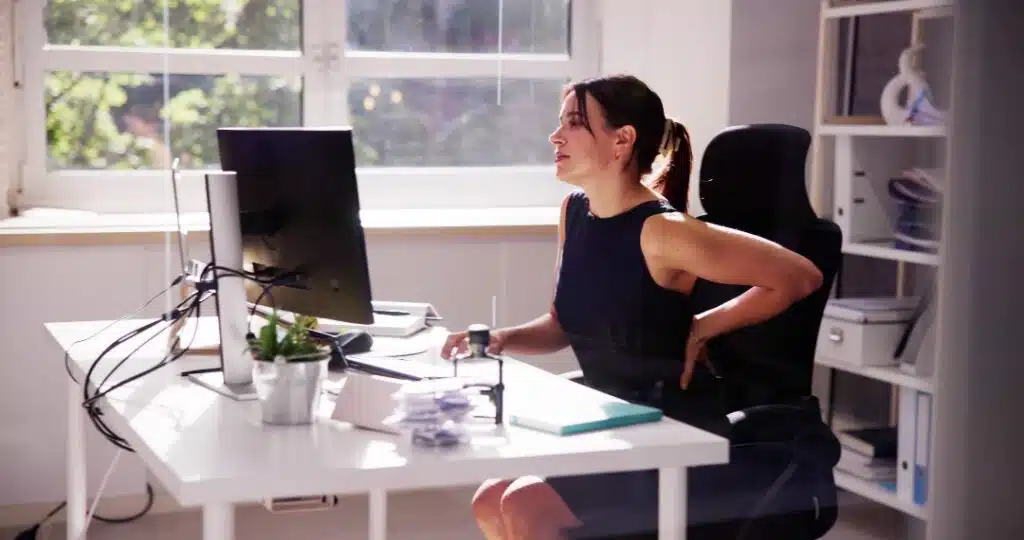
- Screen time: Looking down at your screen for 3 to 5 hours a day tilts your head forward, adding 10 pounds of load to your cervical spine and leading to “tech neck” or neck and shoulder strain.
- Extended sitting: Sitting for more than 30 minutes without changing position can cause the hip flexor muscles to shorten, the pelvis to tilt posteriorly, and the lumbar curve to flatten.
- Weak core muscles: Weak abdominal and back muscles force your spine to rely on its ligaments for support, which is far less efficient and more injury-prone.
- Poorly designed workstations: A monitor placed too low, a chair set at the wrong height, or a keyboard positioned too far forward force your body to twist and slouch just to compensate.
- Lack of movement: Staying stationary for hours deprives discs of their blood supply, which fast-tracks wear and tear and spinal aging.
5 Daily Habits that Improve Your Posture
Improving your posture is about making small, consistent adjustments throughout your day. Here are some healthy spine tips to help you prevent chronic back pain.
1. Maintain A Neutral Spine While Sitting
Sit toward the front edge of your chair with feet flat on the floor, knees at roughly a 90-degree angle, and a slight inward curve in your lower back. Avoid slumping into the backrest for extended periods.

2. Take A Movement Break Every 30 To 60 Minutes
Set a timer to remind yourself to move. Stand up, walk around for two or three minutes, and do a quick stretch. This helps restore the natural hydration cycle to your spinal discs and wakes up your muscles before bad posture can lock in.
3. Strengthen Core Muscles
Doing exercises like planks, bird-dogs, and dead bugs for just 10 to 15 minutes, three or four times a week, wakes up the deep core muscles that protect your lower back.
4. Stretch Regularly
Tight chest and shoulder muscles often pull your body forward, causing a slouched posture. Simple daily stretches can open your chest and improve your back alignment. This not only improves posture but also increases flexibility and prevents stiffness.
5. Practice Proper Standing Posture
When standing, distribute weight evenly across both feet, keep knees slightly soft, tuck the chin gently back to stack the head over the shoulders, and allow the arms to hang naturally. Check your posture during ordinary moments.
Essential Stretches for Better Alignment and Flexibility
The goal for posture stretches is to release the muscles that chronic poor posture overloads and to activate the ones it leaves underused. Perform these stretches daily, or at a minimum, after extended desk sessions.

1. Neck Stretches
Gently tilt your right ear toward your right shoulder and hold it for 20 to 30 seconds, then switch sides. This simple stretch releases the neck and upper back muscles that get tight and overworked from slouching.
2. Shoulder Rolls And Chest-Opening Stretches
Clasp your hands behind your back, gently straighten your arms, and lift slightly while opening your chest. Hold for 20 to 30 seconds. This counteracts the rounded shoulder pattern that develops from sustained forward-facing work.
3. Cat-Cow Spinal Mobility
On your hands and knees, slowly alternate between arching your back up toward the ceiling like a cat and letting your belly dip toward the floor. Move gently and smoothly through both shapes. This stretch wakes up your entire spine by boosting fluid movement from neck to lower back, making it the perfect way to beat morning stiffness.
4. Hamstring Stretches For Pelvic Alignment
Do a standing hamstring stretch or a seated forward fold, holding each for 30 to 45 seconds. Doing this regularly will visibly improve your pelvic alignment and reduce pressure on your lower back.
5. Upper Back Extension
Lie on your back and place a foam roller or rolled towel horizontally right between your shoulder blades. Cross your arms over your chest and let your upper back gently melt over the roller. This simple, relaxing stretch completely reverses the hunched, rounded back that comes from sitting at a desk all day.
Workplace Ergonomics: 7 Tips to Set Up Your Desk for Success
If you spend 40 or more hours a week sitting at a desk, the way your workstation is set up can have a big impact on your spinal health.
Studies found that ergonomic improvements can help reduce the frequency, intensity, and severity of musculoskeletal pain, which affects the bones, muscles, ligaments, tendons, and joints.

1. Chair Adjustment
Adjust your chair height so that your knees form a 90-degree angle with your feet flat on the floor. If your feet cannot rest flat, use a footrest rather than lowering the chair, which can push your knees above hip level.
2. Keep Your Feet Flat on The Floor
Avoid crossing your legs, tucking your feet under your chair, or sitting on your tiptoes. These positions can throw your pelvis out of alignment and put extra strain on your spine. Instead, keep your feet flat on the floor to create a stable base of support to help maintain proper spinal alignment.
3. Keep Your Screen At Eye Level
Position your monitor where it aligns with your natural eye level when seated. The monitor face should tilt back slightly, about 10 to 20 degrees, and the distance from your face should be approximately an arm’s length.
4. Support Your Lower Back
When setting up ergonomics for back pain, make sure your chair’s lumbar support, or a small cushion, fits comfortably against the natural curve of your lower back. Sit all the way back in your chair and place a rolled-up towel or lumbar cushion behind your mid-back to help reduce strain during long periods of sitting.
5. Position Your Keyboard And Mouse
Put your keyboard in front of you so your wrists and forearms stay aligned and your shoulders are relaxed. Keep your mouse within reach on the same surface as your keyboard. Forcing your arms forward to reach either device elevates the shoulders and creates chronic tension.
6. Avoid Forward Head Posture
Your ears should sit directly above your shoulders. If you find yourself leaning toward the screen, the monitor is either too far away, too low, or the text is too small.
7. Schedule Standing Or Walking Breaks
Every 30 to 60 minutes, consider taking a break by standing or walking. Implementing frequent breaks reduces physical and mental strain.
Posture for the Next Generation: A Parent’s Guide
Children and teenagers are developing their musculoskeletal foundations during years when habits and structural adaptations form and change rapidly. Posture patterns established in childhood can persist for decades.
If you have kids and are worried about your child’s spinal health, here are three practical interventions that make the most difference:

- Limit continuous screen time: Device usage among children has accelerated dramatically. A 20-minute break on uninterrupted phone or tablet use, with a standing or active break between sessions, prevents tech neck.
- Encourage active play and physical movement: Activities that build core strength and proprioceptive awareness, such as swimming, climbing, gymnastics, and team sports, develop the muscular foundation that supports healthy spinal alignment throughout childhood and adolescence.
- Teach proper backpack use: A backpack should be worn with both straps, positioned so the bottom of the pack rests at the waistline and the heaviest items are closest to the back. A load exceeding 10 to 15 percent of a child’s body weight, carried asymmetrically, creates lateral spinal loading that accumulates into postural imbalance over a school year.
Early awareness is the goal. Most children do not need clinical intervention. But parents who model good posture habits and create environments that support healthy movement give their children a structural advantage that compounds over a lifetime.
When to Seek Professional Help for Spinal Alignment
Developing healthy posture habits goes a long way in protecting your spine, but there are times when good habits simply aren’t enough.
If you’re experiencing any of the following symptoms and looking for answers on how to improve your posture, a professional evaluation can make a real difference.
- Persistent pain: Neck, shoulder, or back pain that has not improved after two to four weeks of consistent posture-focused habits
- Visibly noticeable posture imbalance: Uneven shoulder height, a head that sits clearly forward of the body’s centerline, or one hip that consistently sits higher than the other
- Frequent headaches: Pain that originates at the base of the skull or radiates from the neck into the head
- Stiffness: Limited range of motion that makes ordinary movements, such as turning the head or bending forward, uncomfortable.
- Neurological issues: Tingling, numbness, or weakness in the arms or legs.
Frequently Asked Questions About Posture Correction
Most people begin noticing meaningful improvements in posture within four to eight weeks of consistent daily practice. Structural changes, including measurable improvement in spinal alignment and reduction in compensatory muscle tension, develop over three to six months of sustained effort.
Yes. Your musculoskeletal system is highly adaptable; the same natural plasticity that let poor posture develop in the first place is what allows you to reshape it. Of course, there are limits for more severe conditions, like significant scoliosis or advanced degenerative disc disease. In those cases, a licensed healthcare provider can help you figure out the best course of treatment.
Tech neck is the result of habitually looking down at our screens, placing approximately 10 pounds of excessive load on the upper spine for every inch of forward head tilt. Over time, this extra weight can alter the spinal curve, leaving you with chronic neck pain, shoulder tension, and radiating headaches.
Chiropractic spinal adjustment targets stiff joints to restore free movement, reduces localized inflammation, and improves brain-to-spine communication. When joint mobility is restored, your muscles and ligaments can easily hold your body in a healthy, balanced alignment.
Your treatment frequency depends entirely on your unique condition, goals, and response to care. If you are managing acute pain or significant misalignment, an initial course of two to three weekly visits allows your spine to progressively respond to treatment. Afterward, maintenance care may require just one visit per month.
A consultation with Houston Spine & Rehabilitation can recommend a schedule based on the initial evaluation and help you determine exactly what your body needs.
Building Strong Habits for Lifelong Spinal Health
Improving your posture is a journey of breaking old patterns and building mindful new habits, not a quick, temporary fix. While small, daily adjustments make a big difference, true progress relies on a clear understanding of your spinal health.
If you’re ready to move beyond self-directed routines and try professional care, schedule a consultation at Houston Spine & Rehabilitation Centers. Our healthcare providers are ready to partner with you to build a personalized treatment plan and provide tips on how to improve your posture over time.